Ceilings under an ice dam
Brown rings and soft patches along the outer edge of upstairs ceilings after a freeze and a thaw.
Ice-dam stain repairsWall and ceiling repair for Ringwood and the lake towns around it
Doorknob holes, hairline cracks from settling, brown rings where an ice dam leaked through, and lower-level walls that drank up groundwater, each brought back level with its surroundings and finished so the mended stretch belongs to the same wall again.
One call starts it. The pro who takes the job rings back, hears the details and gives a figure for the repair ahead of any booking.
Call 7 days, 7am–9pm
After it arrives, the drywall pro who covers Ringwood rings you, asks about the damage and quotes a figure.
A water ring shrinks a little as the board dries, and a crushed corner gets swept up and forgotten. Notes and pictures made on the first day keep details that are gone by the following week, and those details are what an adjuster or a property manager tends to want. Filing anything is your decision and your carrier's. This list only covers making the record easy to follow.
Those pictures double as the start of a quote. Texted to the number beside the business name, they reach the pro who prices the job.
A recently built house, a new addition or a lower level finished last winter goes through a period of adjustment. Framing lumber is delivered with moisture still in it and loses that over its first two or three winters of furnace heat, and the shrinking wood tugs at the sheets screwed to it. That alone says nothing bad about how the house was put together. It does leave recognizable marks.
Little raised dimples or crazed circles lined up vertically, the next line roughly sixteen inches over. When a stud dries and draws back from the sheet, the screw or nail head ends up perched above the face of the board. A sound fix drives a fresh screw an inch or two above and below each one, sets or pulls the original, and buries all three under thin, wide coats. Paint alone over a pop lets it push through again.
A crack that opens along the joint between an inside wall and the ceiling in cold months and shuts again by July. With some roof framing, the upper chords of each truss sit in chilly, damp attic air and grow slightly, while the lower chords stay warm and dry beneath the insulation, so the whole truss arches and lifts the ceiling sheets. Fresh tape on that corner seldom survives a winter. The approach that lasts lets the ceiling float: its sheets are released from the wall's top plate and carried on clips, or a crown molding is nailed to the ceiling alone so it travels up and down with it.
Fine diagonals rising off the upper corner of a doorway mark where the framing flexes most. The fix widens the line a touch, beds tape over it and feathers the joint so it can give with next season's movement. A gap that swallows the edge of a business card, a door that begins to stick, or a line that keeps lengthening belongs in another category, and the page on where ordinary settling ends and a structural question starts explains how to tell.
Most household damage lands in one of these four. On each page: why the damage happens, the order a careful repair goes in, and what nudges the cost up or down.
Brown rings and soft patches along the outer edge of upstairs ceilings after a freeze and a thaw.
Ice-dam stain repairsFinished basement walls that wicked water from the slab and need trimming back to sound gypsum.
Wet basement drywallDiagonals off door corners, split seams and gaps at the ceiling line, taped so they can flex.
Settling cracks in walls and ceilingsDoorknob holes, anchor pull-outs, dents and chipped outside corners, filled and finished level.
Patching holes and cornersSanded joint compound turns into a pale flour that drifts wherever the heating system carries air. Careful prep separates a two-foot patch from a whole-house dusting, and asking how the room will be protected, before a date is chosen, is a reasonable question.
Anyone in the house with asthma, or an animal that can't be moved to another floor, is worth bringing up on the first call so the setup accounts for it.
Ringwood is a Passaic County borough whose 28.49 square miles held 11,735 people in the 2020 census, a lot of ground for that population. Much of it is the Ramapo Mountains and Ringwood State Park, which takes in Ringwood Manor, the New Jersey State Botanical Garden at Skylands and Shepherd Lake, and the Wanaque Reservoir divides the borough in two. Homes cluster around the private lake communities of Cupsaw Lake, the Erskine Lakes and the Skyline Lakes, and in places such as Stonetown and Conklintown.
For walls, the weather counts for as much as a house's age. The borough's climate is classed as hot-summer continental, with muggy summers and cold winters, and an average year brings a little over 48 inches of rain and melted snow. A heavy load of snow on the roof, rain driving at a foundation and a long furnace season are what put rings and cracks on drywall.
At the 2020 count, 4.2 percent of the borough's housing units stood empty, and the Census Bureau's 2024 five-year estimates place the median owner-occupied value at $449,800. With values like that, a stained ceiling or a line of popped screws deserves a proper repair ahead of listing a house or signing a new tenant.
A repair can be flat, smooth and level and still stand out once the paint dries. Porosity, sheen and texture are usually to blame, and each one has a remedy that belongs inside the job rather than after it. The guide walks through all three, in the order a blended repair follows, and sits with any later pieces on the guides page.
Nothing gets opened up until you have heard the figure and agreed to it. There is more on how a repair is arranged and what the price covers.
These are common patterns, described in general terms. Each one calls for its own fix.
A tan or brown ring, sometimes with a soft center, a foot or two in from an outside wall. Ice built up along the roof edge, meltwater backed under the shingles and found the ceiling. Once the roof has been sorted out and the board has dried, a ceiling that is still firm gets a coat of stain-blocking primer and fresh ceiling paint; a section that has gone soft or sagged is cut out to the joists and replaced.
Board along the floor that looks swollen, flaky or stained in a band a few inches high. Gypsum pulls water upward much like a paper towel. The usual remedy is a level cut taken above the highest damp mark, soggy insulation pulled, the cavity dried thoroughly, and fresh panels hung with their bottom edge clear of the concrete.
A doorknob-sized break where a door swung hard and had no stop. Filler alone won't bridge it. A replacement piece is shaped to the opening, screwed to wooden cleats fixed behind it, then taped and finished. A door stop installed afterward spares the wall a repeat.
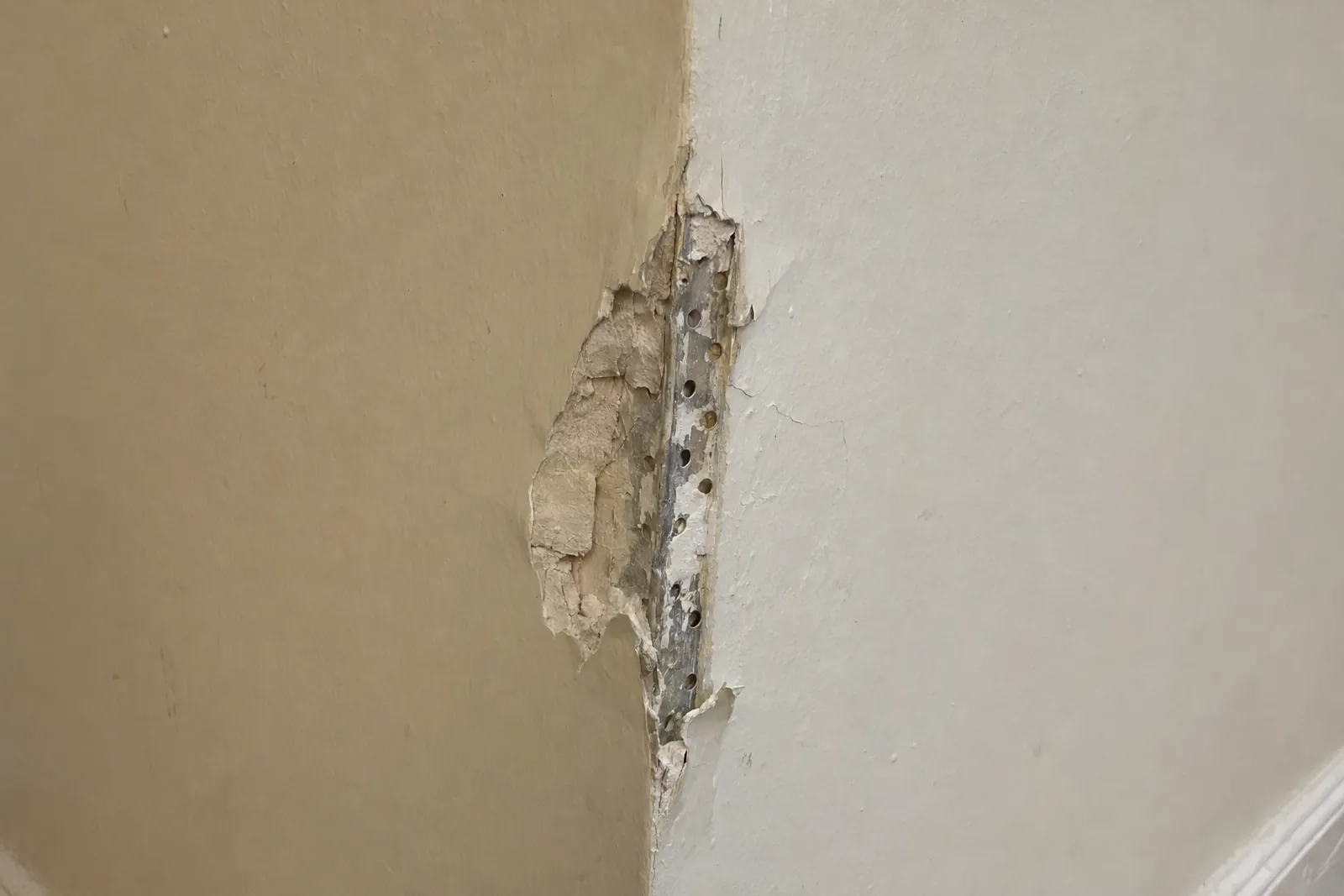
An outside corner clipped by furniture or a vacuum, with the metal bead showing through. Bent bead is cut out and replaced; bead that is still straight gets fresh compound built over it and feathered onto both faces.
There are three ways a damaged wall usually gets put right. Which one fits depends on how much is damaged and why.
| Patch in place | Cut out and replace a section | Skim coat the surface | |
|---|---|---|---|
| Suits | Holes no wider than a palm, pops, dents, short cracks | Wet, crumbling or sagging board, and holes too big to patch | Walls with many small flaws or torn paper facing |
| How much is opened | Only the damaged spot | Back to the studs or joists on each side | Nothing; compound goes over the face |
| Coats and drying | Two or three thin coats | Tape, then two or three coats on every seam | One to three full coats across the wall |
| Blending | Feathered a foot or more past the damage | Seams feathered wide, texture laid over the new piece | The whole wall becomes the new surface |
| Paint afterward | Spot-primed, then the wall rolled corner to corner | Primed, then the full wall or ceiling painted | Whole wall primed and painted |
Work centers on Ringwood itself, covering Skyline Lakes, Erskine, Cupsaw Lake, Monksville, Stonetown and Conklintown, and reaches into the towns that share its borders.
Each town gets a little more detail on the page listing every town and lake area we serve.
A patch is half a repair until color goes over it, so decide early who takes care of that part. Some owners like the wall left primed so they can paint it on their own schedule; others want the pro to carry on through the finish coat. Say which on the call and the quote will include it.
New mud absorbs paint much more greedily than an old painted wall does. A topcoat laid straight on it cures flatter, and in low side light the repair shows up as a dull rectangle. Primer or sealer evens out that thirst so the final coat dries to one sheen everywhere.
Walls are mostly flat, matte or eggshell, and ceilings are nearly always flat. A leftover can from the last repaint makes the closest match if it was stored sealed, though even the right color dabbed onto a small square can stand out, since paint drifts as it ages on the wall. Taking the roller from one corner of the wall to the other removes the edge.
Where a wall carries orange peel or knockdown, the texture is applied to the patch and left to dry before any primer. A smooth patch in a textured wall stands out regardless of the paint. The patch-blending guide goes further into each of these.
Two lines and one photo will do. Say which room, how wide the damage spreads, and whether any of it still feels damp to the touch.
From there, a nearby drywall pro takes the details in hand and works out what the repair should cost.